
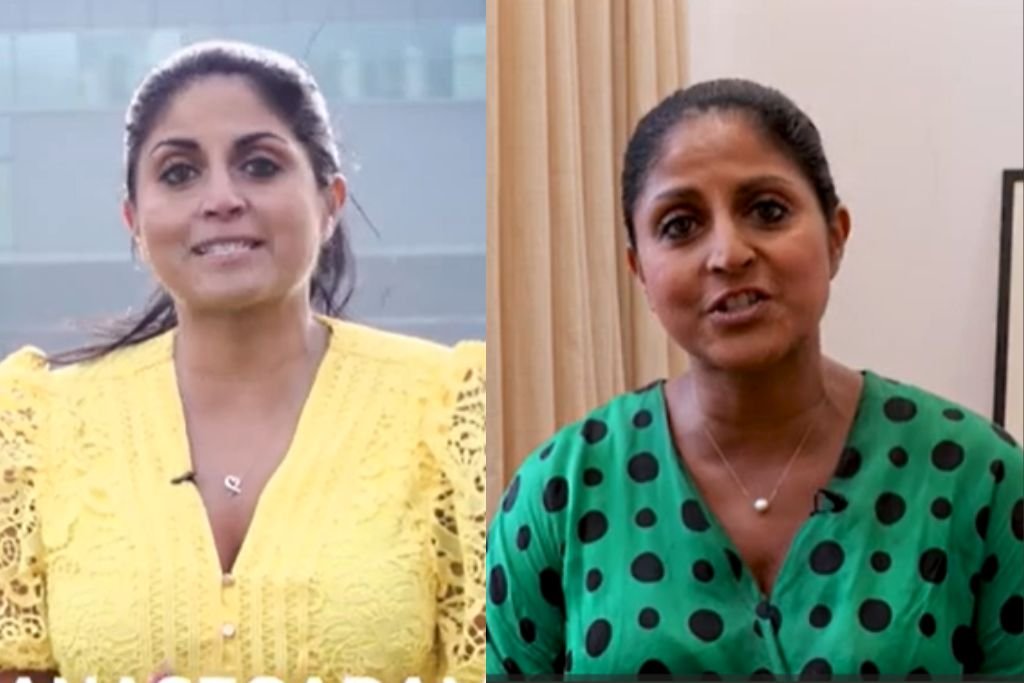
When you hear the name Karthi Gnanasegaram, you might immediately think of major sporting events, Wimbledon, the BBC, or live television coverage. But her story goes far beyond sports broadcasting.
Karthi Gnanasegaram has built a career that brings together television, radio, journalism, sport, classical music and academic study. Over the years, she has appeared in some of the biggest broadcasting environments, working with organisations and platforms including the BBC, Classic FM, Sky Sports, Amazon Prime Video and Premier League Productions.
What makes her story particularly interesting is the journey behind the camera. Before she became a familiar face and voice in broadcasting, she was already developing interests in sport, music, writing and education.
Her story began in Birmingham and continued through Wolverhampton before taking her to Cambridge. There, she studied Classics, played competitive university sport and developed her skills as a writer and communicator. Eventually, those experiences helped shape the broadcaster audiences know today.
From Birmingham to Wolverhampton
Let us begin where Karthi Gnanasegaram’s story began: the West Midlands.
She was born in Birmingham and grew up in Wolverhampton. During her school years, travelling between Wolverhampton and Birmingham became part of her everyday routine. Birmingham’s New Street Station was a familiar part of that journey.
Looking back at her career, that early connection with travel seems almost symbolic.
Her professional life would later take her from television studios to football grounds, tennis courts, Olympic venues, radio stations and classical-music programmes.
But even during childhood, her interests were already spread across several areas.
Sport was important to her. Music was important to her. Education was important to her. Rather than choosing one interest and leaving the others behind, she continued developing all of them.
That combination would eventually become one of the most distinctive features of her career.
Cambridge Changed the Direction of Her Story
The next major chapter came when Gnanasegaram went to Emmanuel College, Cambridge, where she studied Classics.
At first, studying Classics might not sound like the obvious preparation for a career in sports broadcasting. But when we look more closely, the connection becomes easier to understand.
Classics involves language, history, culture, interpretation and communication. Those are also important skills for someone working in journalism and broadcasting.
At Cambridge, Gnanasegaram continued to explore different interests. She wrote for the student newspaper Varsity and became involved in several sports, including tennis, badminton and hockey.
And it was tennis that would become especially important.
She was not simply someone watching sport from the sidelines. She had experienced competition herself.
She understood what it meant to train, compete and perform under pressure.
Years later, that experience would become particularly useful when she began reporting from some of the world’s biggest sporting events.
Tennis Became Part of Her Professional Identity
For Karthi Gnanasegaram, tennis has never been just another assignment.
Her relationship with the sport began during her university years, when she represented Cambridge in tennis.
Eventually, the university tennis player would find herself working around some of the most prestigious tennis tournaments in the world.
And that creates an interesting connection.
When a broadcaster covers a major tennis tournament, the job is not simply to announce who won a point or who is serving next. The story is also about pressure, momentum, tactics, personality and emotion.
A match can change within seconds.
A player can move from confidence to frustration after a single point. A comeback can completely change the atmosphere inside a stadium.
The broadcaster has to recognise those moments and explain them to an audience watching from thousands of miles away.
Gnanasegaram’s own sporting background gives her an understanding of that environment that goes beyond statistics.
Her work has included Wimbledon and other major tennis competitions, and her association with the Championships has continued over the years.
In 2026, broadcasting records show her working as a reporter during Wimbledon, covering matches on the world feed.
That continued involvement tells us something important about her career. She has not simply become associated with sport because of an early opportunity. She has continued to remain part of a constantly changing broadcasting industry.
From Journalism to the World’s Biggest Sporting Events
The road from Cambridge to major international sporting events was not an overnight journey.
Gnanasegaram gradually developed experience through journalism, sports presentation and broadcasting before reaching some of the biggest stages in international sport.
Her professional work has included coverage connected with the Olympic Games, FIFA World Cup, French Open tennis, Champions League football, golf championships, Ryder Cup competitions, cricket and other major sporting events.
That kind of career requires flexibility.
A presenter cannot approach every sport in exactly the same way.
Football has its own language, personalities and tactical stories. Tennis depends heavily on momentum and individual battles. Olympic coverage can involve completely different sports, rules and traditions within the same broadcasting environment.
The presenter has to adapt quickly.
They have to understand enough about each event to ask useful questions, explain what is happening and communicate its importance to viewers.
That ability to move between different sporting environments has become one of Gnanasegaram’s strongest professional qualities.
Her BBC Career Expanded Her Broadcasting Range
When people search for Karthi Gnanasegaram, the BBC is often one of the first names they encounter.
Her connection with the BBC has played an important role in establishing her public broadcasting profile.
But her work has not been restricted to sports.
She has appeared across BBC television and radio, with work associated with BBC Sport, BBC News and BBC radio programming.
And that distinction matters.
Sports broadcasting and news broadcasting may share certain skills, but they require different approaches.
Sports coverage often demands energy, emotion and a strong understanding of competition.
News presentation requires clarity, accuracy and restraint.
A broadcaster who can move between those environments has to understand not only what information should be communicated, but also how it should be communicated.
Gnanasegaram’s career demonstrates that ability to change tone without losing authority.
That is why describing her simply as a sports presenter does not tell the whole story.
She has developed into a broader broadcasting professional.
Her Olympic Experience
Now imagine the scale of the Olympic Games.
Athletes from around the world arrive at one event. Multiple competitions take place across different venues. Audiences want immediate results, but they also want stories.
For broadcasters, the Olympics can be one of the most demanding assignments imaginable.
Gnanasegaram has been involved in Olympic coverage, including work around the Rio 2016 Games.
Her Olympic experience also highlights just how broad her sporting knowledge has become.
Her broadcasting work has included tennis as well as sports such as diving, judo and taekwondo.
A presenter does not need to become an expert athlete in every discipline. But they do need to understand the fundamentals, know what questions matter and recognise why a particular performance is significant.
That is what makes Olympic broadcasting such a strong test of versatility.
And Gnanasegaram’s career shows that she has been able to meet that challenge.
Then Came an Unexpected Chapter: Classical Music
Now we come to perhaps the most surprising part of Karthi Gnanasegaram’s story.
It is not sport.
It is music.
Long before she became a familiar broadcaster, Gnanasegaram had developed a serious musical background. She reached Grade 8 standard in both violin and piano and performed with orchestras during her school years.
Eventually, that musical interest became part of her professional broadcasting career.
Since 2017, she has presented for Classic FM and has expanded her work into classical-music broadcasting.
She has also been involved in programmes exploring the relationship between music and sport.
At first, sport and classical music might seem like two completely different worlds.
One takes place in stadiums and arenas, filled with competition and adrenaline.
The other is associated with concert halls, composers and musicians.
But Gnanasegaram’s career shows that these worlds may have more in common than we initially think.
Both require discipline.
Both require preparation.
Both involve performance under pressure.
And both can tell powerful stories about ambition, failure, resilience and achievement.
An Olympic athlete and a concert musician may work in completely different environments, but both understand what it means to prepare intensely for a moment when their performance becomes public.
That makes Gnanasegaram’s move into classical-music broadcasting feel less unexpected.
A Broadcaster Who Understands Performance
There is one word that perhaps connects the different parts of Gnanasegaram’s career particularly well: performance.
She is not simply delivering information.
She is working at the point where journalism and performance meet.
A presenter needs to know when to speak.
They need to know when to listen.
They need to know when to ask a question.
And sometimes, most importantly, they need to know when to stop talking and allow an important moment to breathe.
That is especially true in live sport.
A tennis match can change in seconds. A football interview can suddenly produce one sentence that becomes the headline. An Olympic performance can turn emotional without warning.
The broadcaster has to recognise those moments.
Gnanasegaram’s background in sport and music gives her an interesting perspective on performance. She has experienced preparation and performance herself, while journalism has taught her how to understand and explain the performances of others.
That combination is difficult to create artificially.
Her Career Beyond the BBC
Although the BBC remains an important part of her professional story, Gnanasegaram’s career has expanded across several broadcasting organisations and platforms.
Her professional portfolio has included work associated with Sky Sports, Amazon Prime Video and Premier League Productions, alongside her classical-music broadcasting.
This reflects the way sports media has changed.
Today, a presenter is no longer necessarily connected to just one television network.
The same journalist can appear on traditional television, streaming platforms, radio, digital coverage and live sporting events.
Gnanasegaram’s career fits naturally into this changing media environment.
Her ability to work across different formats has helped her remain relevant while the broadcasting industry itself continues to evolve.
Why Her Private Life Attracts Attention
When people search for Karthi Gnanasegaram online, they often want to know more than just her professional history.
Questions about her age, parents, husband, partner and family frequently appear.
But there is an important difference between public interest and publicly verified information.
Her professional career is well documented.
Her private life is much less so.
There is no reliably confirmed public information establishing a husband or current romantic partner, while her exact date of birth has also not been firmly established through authoritative public biographies.
That means it is important not to turn online speculation into fact.
A broadcaster can have a highly visible career while choosing to keep personal matters private.
Gnanasegaram appears to have maintained that boundary.
Instead of making celebrity lifestyle the centre of her public identity, she has largely allowed her professional work to define her.
What About Karthi Gnanasegaram’s Age?
Age is one of the most common questions surrounding Gnanasegaram.
But this is also an area where online information needs to be approached carefully.
Different websites have published different estimates and birth-year claims. However, there is no sufficiently authoritative public confirmation of an exact date of birth that would allow a specific age to be presented as established fact.
So, the safest conclusion is simple: Karthi Gnanasegaram’s exact age has not been reliably confirmed publicly.
That may sound like a small detail, but it demonstrates a larger problem with online biography content.
A claim can be repeated by several websites and still remain unverified.
Rather than repeating uncertain information, the stronger story is the one that can actually be documented.
Her education.
Her sporting experience.
Her journalism.
Her broadcasting career.
Her work with major sporting events.
And her continued presence across television and radio.
Those are the elements that genuinely define her professional journey.
A Career That Crosses Culture and Broadcasting
There is also something interesting about where Gnanasegaram’s career sits within modern British broadcasting.
Her background and interests reflect a Britain where different cultural experiences and professional identities increasingly overlap.
But she has never needed to reduce herself to a single label.
She is a broadcaster.
She is a sports journalist.
She has a strong connection with tennis.
She is a classical-music presenter.
She studied Classics.
She has worked in both television and radio.
And perhaps that combination is exactly what makes her career distinctive.
Calling her simply a BBC sports presenter captures only one part of the story.
The larger picture is much broader.
What Makes Karthi Gnanasegaram Different?
Broadcasting is full of talented presenters.
So what allows someone to build a career that continues across different programmes, sports and platforms?
In Gnanasegaram’s case, the answer appears to be a combination of preparation, versatility and curiosity.
She can discuss sport without reducing it to statistics.
She can introduce classical music without making it feel inaccessible.
She can work in television as comfortably as in radio.
And she can move from major international sporting events into more reflective cultural broadcasting.
That flexibility has helped her career develop through different generations of media.
When she entered broadcasting, traditional television networks dominated the industry.
Today, streaming services, digital audiences and specialist sports platforms play an increasingly important role.
The platforms have changed.
But the fundamental skills of broadcasting remain the same.
Know the subject.
Understand the audience.
Communicate clearly.
And recognise the moment.
Karthi Gnanasegaram in 2026
By 2026, Karthi Gnanasegaram remains active in sports broadcasting, with tennis continuing to play an important role in her professional work.
Her recent Wimbledon reporting demonstrates that her expertise remains relevant at one of the world’s most prestigious tennis events.
But perhaps the bigger story is that she no longer needs a single label.
She has built a career across sport, news, radio and classical music.
That kind of range is unusual.
Modern media often encourages people to specialise. Presenters are frequently associated with one subject, one platform or one carefully defined public identity.
Gnanasegaram represents another model.
She is a broadly educated broadcaster whose strength comes from being able to enter different environments, understand their language and communicate their stories to an audience.
A Career Driven by Curiosity
If there is one lesson to take from Karthi Gnanasegaram’s journey, it may be that success does not always require choosing one interest and abandoning everything else.
She carried several interests with her.
Sport became broadcasting.
Music became broadcasting.
Academic study helped develop her communication skills.
Writing and journalism developed alongside presenting.
The subjects may appear different, but they have gradually connected into one professional story.
And that may be her greatest strength.
Gnanasegaram has shown that a broadcaster does not have to choose between intellectual curiosity and entertainment.
There is room for sport and culture.
There is room for journalism and scholarship.
There is room for television and radio.
Her career demonstrates that these different interests can strengthen one another.
The Story Behind the Broadcaster
So, when we look at Karthi Gnanasegaram’s career, we are not simply looking at the story of a television presenter.
We are looking at the story of someone who built a professional life around curiosity and versatility.
Her journey began in Birmingham and Wolverhampton.
It continued at Cambridge, where she studied Classics and played university sport.
From there, her path moved into journalism and broadcasting.
Then came major sporting events, including Wimbledon and the Olympic Games.
Alongside sport, another part of her identity continued to grow: classical music.
Eventually, those different interests came together in a career spanning television, radio, sport, news and music.
That is what makes her story worth telling.
The questions surrounding her private life may attract online attention, but they are not the strongest part of the story.
The stronger story is the career itself.
Karthi Gnanasegaram has created a professional identity built on preparation, knowledge, adaptability and performance.
She has demonstrated that sport can exist alongside music, journalism alongside scholarship, and television alongside radio.
And perhaps that is the final message from her journey.
In a broadcasting industry where attention can often be loud and temporary, lasting authority can come from something much quieter: knowing your subject, understanding your audience, staying curious and allowing the quality of your work to speak for itself.