
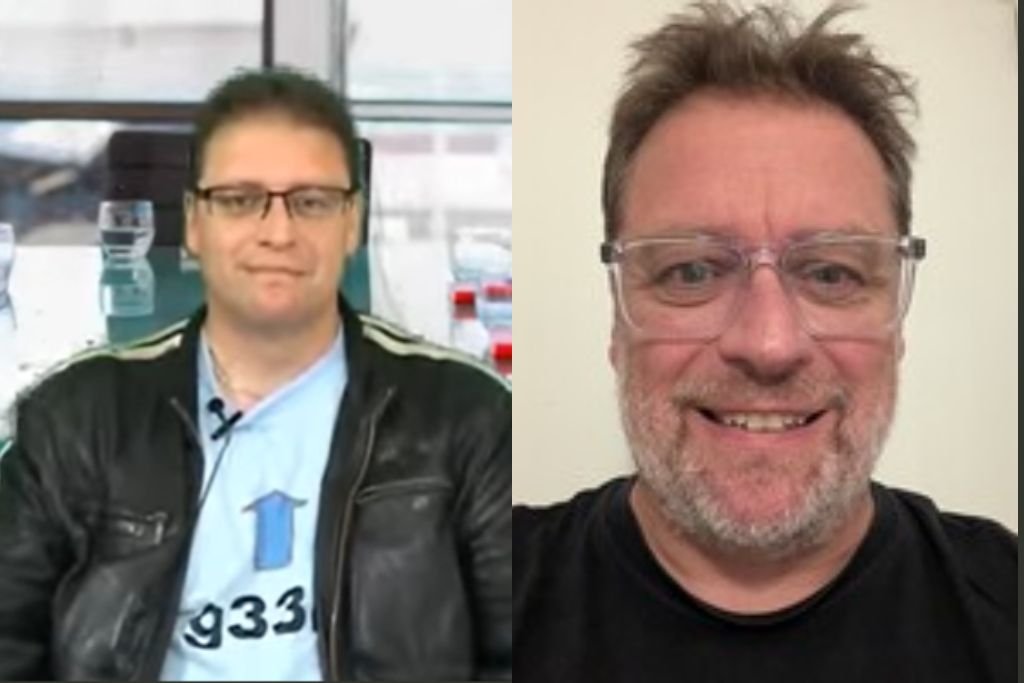
When we talk about people who have spent years exploring the future of technology, one name that deserves attention is Ian Hughes, better known to many online as epredator.
His story is not simply the story of a technology professional. It is the story of a man who repeatedly found himself standing at the edge of the next technological change, asking what would happen if people began interacting with technology in completely different ways.
From virtual worlds and the early days of immersive online environments to the Internet of Things, digital twins, augmented reality and the metaverse, Ian Hughes has followed a remarkably consistent path. He has watched technologies develop, experimented with them, explained them to businesses and audiences, and often discussed ideas years before they became mainstream subjects.
And if Hughes were to tell his own story, it would probably not begin with the metaverse.
It would begin with curiosity.
The Story Begins With Technology
Ian Hughes’ professional journey developed during a period when technology was changing at extraordinary speed.
The internet was moving from something relatively unfamiliar into a fundamental part of modern life. Websites were becoming more sophisticated, businesses were moving online and software was beginning to influence almost every major industry.
Hughes became part of that transformation through his work in technology development and consulting.
For around two decades, he worked with IBM, gaining experience in cross-industry application development. His professional work exposed him to different sectors and different technological challenges, including automotive, retail, telecommunications and major international sporting events.
That experience would become an important part of his later career.
Rather than seeing technology as something belonging to one particular industry, Hughes developed an understanding of how digital systems could change very different environments.
And then came a technology that would help define his public identity.
The Arrival of epredator
For many people, the name Ian Hughes became closely connected with another name: epredator.
It was his online identity during the period when virtual worlds were beginning to attract serious attention.
Around the middle of the 2000s, virtual environments such as Second Life were creating a new kind of online experience. People were no longer simply visiting websites. They could enter digital spaces, create avatars, communicate with others and interact with environments that continued to exist beyond a single session.
For Hughes, this was more than an interesting online experiment.
He became involved in helping IBM colleagues explore virtual worlds and investigate what these environments could mean for business and collaboration.
At the time, the idea of companies operating inside virtual worlds sounded unusual to many people.
But Hughes was looking at the possibilities.
What if employees could meet inside a shared digital environment?
What if companies could build virtual demonstrations?
What if a three-dimensional environment could be used for collaboration, training or experimentation?
Those questions placed Hughes at the center of an emerging conversation about what online interaction might eventually become.
When Virtual Worlds Became Serious Business
As the interest in virtual worlds grew, Hughes became an important voice in explaining their potential.
He helped develop and promote enterprise-focused virtual-world initiatives, particularly during his time connected with IBM.
For Hughes, virtual worlds were not simply about entertainment. They represented a different interface between people and information.
Instead of looking at a collection of windows and documents on a computer screen, people could enter an environment.
They could see things around them.
They could interact with other people through avatars.
They could demonstrate ideas spatially.
And they could potentially use these environments to simulate situations that would be expensive, dangerous or difficult to reproduce in the physical world.
That vision would later become remarkably familiar.
Years later, the technology industry would begin talking about the metaverse.
But Hughes had already been exploring many of the ideas that would become part of that conversation.
The Man Behind the Metaverse Conversation
When the word “metaverse” eventually became one of technology’s biggest buzzwords, Hughes was already familiar with its underlying concepts.
His view of the metaverse was broader than simply putting on a virtual-reality headset.
He was interested in the relationship between physical reality and digital information.
Imagine, for example, a physical machine inside a factory.
The machine produces data.
Sensors monitor its condition.
Software analyzes its performance.
A digital representation of that machine can be created.
Engineers can examine the digital model, run simulations and potentially understand what could happen to the real machine under different conditions.
Now imagine being able to see that information through augmented reality while standing beside the machine.
Suddenly, the line between the physical and digital worlds begins to disappear.
This is the type of technological convergence that has been central to Hughes’ thinking.
From Virtual Worlds to the Internet of Things
As Hughes’ career progressed, his attention moved increasingly toward the Internet of Things.
And this transition makes sense when we look at his earlier work.
Virtual worlds were about digital environments.
The Internet of Things is about physical objects becoming connected to digital systems.
A sensor can collect information from a machine.
A connected device can transmit that information.
Software can analyze it.
A digital model can represent it.
And a person can then interact with the information through a computer, phone, augmented-reality system or another interface.
For Hughes, these were not isolated technological developments.
They were different pieces of a much larger story.
His work as a Senior Research Analyst at 451 Research placed him directly within this evolving field. His research examined areas including industrial IoT, digital twins, simulation and edge technologies.
And here, once again, his interest moved beyond the technology itself.
The bigger question was always about what the technology could actually change.
Why Digital Twins Became Important
One of the concepts associated with Hughes’ work is the digital twin.
To understand it simply, imagine creating a digital version of a real-world object, machine, building or process.
That digital representation can receive information from the physical object.
The real machine changes.
The digital model changes.
Data moves between the physical and digital environments.
The result can help engineers and organizations understand what is happening in the real world.
It can also allow them to test possibilities before making expensive physical changes.
This idea connects closely with Hughes’ earlier fascination with virtual environments.
The difference is that the virtual world is no longer completely separate from reality.
Instead, it becomes connected to reality through data.
And this is where Hughes’ career becomes especially interesting.
The virtual worlds of the 2000s and the industrial digital twins of later years may appear to belong to completely different technological eras.
But both involve creating digital representations that help humans understand and interact with complex systems.
A Career That Crossed Technology Boundaries
Hughes has never been easy to place inside one simple professional category.
He has worked as a developer, architect, consultant, analyst, writer and technology communicator.
He has also worked across different industries and different generations of technology.
That variety is important because technology does not develop in isolated compartments.
The internet affects business.
Business affects communication.
Communication affects social behavior.
Connected devices produce data.
Data creates new applications.
Applications require new interfaces.
And new interfaces change how people interact with machines.
Hughes’ career has repeatedly moved across those boundaries.
That is one reason his work has remained connected to emerging-technology discussions even as individual technologies have changed.
Ian Hughes in Front of the Television Camera
At one point, Hughes’ technology journey moved from professional research into television.
Between 2010 and 2011, he presented technology-related features for the children’s programme The Cool Stuff Collective.
For a technology professional, explaining advanced concepts to children can be a completely different challenge from explaining them to engineers or business executives.
There is no room for unnecessary technical language.
The idea has to be demonstrated.
It has to be made visual.
And most importantly, it has to become interesting.
Hughes explored subjects such as 3D printing, scanning, haptics and virtual worlds.
That television experience demonstrated another part of his professional personality.
He was not only interested in understanding technology.
He wanted other people to understand it too.
The Author Behind the Technology Professional
There is another side to Ian Hughes that deserves attention.
He is also a writer of science fiction.
Using the name epredator, he wrote the novels Reconfigure and Cont3xt.
Science fiction gave Hughes a different way to explore the same questions that appeared throughout his professional career.
What happens when technology becomes more powerful?
What happens when virtual and physical realities begin to overlap?
How does society change when people depend on increasingly advanced digital systems?
These questions can be explored through research, but fiction provides another opportunity.
A research report can describe what a technology does.
A novel can ask what that technology might mean for a human being.
And Hughes has used both approaches.
A Passion for STEM Education
While much of his career has focused on professional technology, Hughes has also spent time helping young people discover the possibilities of science and technology.
As a STEMNET ambassador, he has gone into schools to promote science, technology, engineering and mathematics.
His activities have included talks, group sessions and demonstrations designed to make STEM subjects more engaging.
If Hughes were explaining this part of his story, the message would likely be straightforward.
The technologies that adults are discussing today will eventually be built and changed by today’s students.
A child watching a demonstration of a new technology is not simply learning about a gadget.
That child could one day become the engineer who develops the next generation of it.
For someone whose own career has been shaped by curiosity about emerging technology, encouraging that curiosity in young people represents a natural extension of his work.
The Unexpected Connection With Martial Arts
There is also a surprisingly different chapter in Hughes’ life.
Away from technology, he has a long-standing connection with Cho Kwang Do, a martial art in which he has achieved a second-degree black belt and worked as an instructor.
At first glance, martial arts and emerging technology may seem like completely unrelated subjects.
But there is a common idea between them.
Practice.
Technology changes constantly, and anyone working in the field has to keep learning.
Martial arts also require continuous learning, repetition and discipline.
A technique is practiced repeatedly.
A mistake is corrected.
A skill improves.
Then the process begins again.
In that sense, the two sides of Hughes’ life are not necessarily as different as they first appear.
Recognition for a Technology Career
In 2018, Hughes received an Honorary Doctorate of Technology from Solent University.
The recognition represented another milestone in a career that had already crossed virtual worlds, software development, emerging technologies, education and public communication.
By this point, Hughes had established himself not simply as someone who worked with technology, but as someone who helped explain where technology might be heading.
That distinction is important.
Technology professionals often concentrate on building things.
Researchers analyze them.
Journalists explain them.
Consultants help organizations use them.
Hughes’ career has included elements of all these roles.
Looking Beyond the Buzzwords
Perhaps the most important thing to understand about Ian Hughes is that his story is not really about one particular buzzword.
It is not only about the metaverse.
It is not only about virtual worlds.
It is not only about the Internet of Things.
It is not only about digital twins.
These subjects are connected by a larger question.
How will technology change the relationship between people, information and the physical world?
That question has followed Hughes through different stages of his career.
When virtual worlds were new, he explored how people could communicate inside them.
When connected devices became increasingly important, he examined how physical objects could generate and exchange data.
When digital twins developed, he explored how physical systems could be represented digitally.
And when the metaverse became a major technology conversation, his previous experience gave him a perspective shaped by years of watching immersive technologies evolve.
The End of One Professional Chapter
Hughes’ professional biography records his retirement from 451 Research in December 2025, following years as a Senior Analyst focused on the Internet of Things.
But retirement from a professional position does not necessarily mean retirement from curiosity.
The technologies that shaped his career continue to evolve.
Artificial intelligence is changing software development.
Robotics is becoming more capable.
Digital twins are developing across industrial environments.
Augmented and spatial computing continue to evolve.
Connected devices are becoming more common.
And the metaverse conversation itself continues to change.
The future that Hughes spent years discussing is therefore still being built.
Why Ian Hughes’ Story Is Worth Remembering
So, who is Ian Hughes?
He is a British technology professional known widely by the online name epredator.
He is a developer who moved into consulting and research.
He is someone who explored virtual worlds before the metaverse became a mainstream technology term.
He is an Internet of Things analyst who examined digital twins and industrial technology.
He is a writer who used science fiction to explore possible technological futures.
He is a television presenter who helped young audiences understand emerging technology.
He is a STEM ambassador who has taken technology discussions into schools.
And he is also a martial artist who has spent years practicing discipline away from the computer screen.
But perhaps the simplest way to describe Ian Hughes is this:
He has spent much of his career asking what comes next.
While others were still becoming comfortable with one technological development, Hughes was often looking toward the next one.
Virtual worlds led to new ideas about immersive interaction.
Connected devices created new relationships between physical objects and data.
Digital twins created new ways to represent reality.
The metaverse brought many of these ideas together.
And through all of it, Hughes remained interested in the same fundamental subject—the future relationship between humans and technology.
His story is therefore not just a biography of one technology professional.
It is also a reflection of how quickly technology has changed over the past few decades.
The internet that once seemed revolutionary became ordinary.
Virtual worlds that once seemed experimental became part of a much larger immersive-technology conversation.
Connected devices moved from niche applications into everyday life.
And concepts that once belonged to science fiction began appearing in workplaces, schools, factories and homes.
Ian Hughes, or epredator, has spent much of his career standing somewhere along that boundary between what exists today and what might exist tomorrow.
And perhaps that is the most fitting way to tell his story—as the story of a man who kept looking beyond the present, trying to understand what the next version of technology might mean for all of us.