
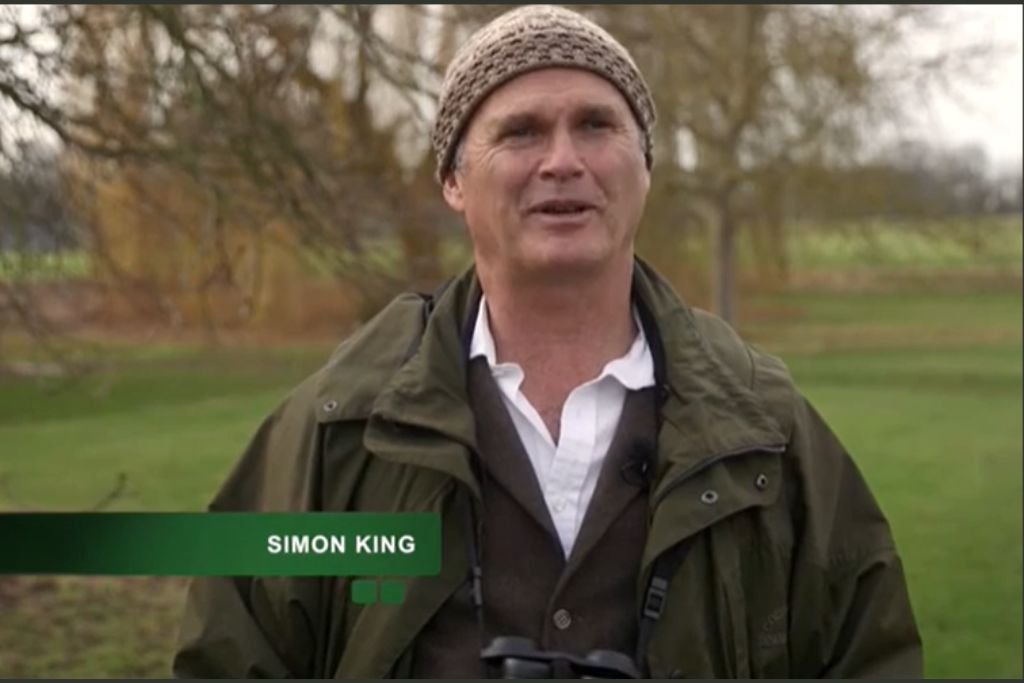
When people hear the name Simon King, many immediately remember the wildlife programmes that once brought Britain’s forests, fields and Africa’s spectacular landscapes into their living rooms. But behind that familiar face was a man whose connection with nature began long before television made him famous.
Simon King, the British naturalist, wildlife filmmaker, cameraman, presenter, author and conservationist, built his entire career around one powerful fascination: the natural world.
For decades, he became one of the recognisable voices and faces of British wildlife broadcasting. Viewers saw him in programmes such as Big Cat Diary, Springwatch and Autumnwatch. Behind the camera, however, his work reached even further, with involvement in major productions including The Blue Planet, Planet Earth and Life.
And when people later began asking, “What happened to Simon King?”, the story was not really about a career disappearing. It was about a career changing direction.
Simon King did not leave wildlife behind. Instead, he moved deeper into it.
The Story Begins in Nairobi
Simon Henry King was born on 27 December 1962 in Nairobi, Kenya. His childhood began in a part of the world where wildlife was never simply something seen on television. It was part of the environment around him.
His father, John King, worked in broadcasting, and the family eventually moved to Britain. Simon later grew up in Bristol, but his fascination with animals remained with him.
Even as a child, King wanted to understand animals rather than simply watch them.
There is a story from his childhood that captures this perfectly. He once joked that he wanted to become an elephant when he grew up.
It may sound like an amusing childhood comment, but looking back at his career, it seems to reveal something important about him. He was fascinated by the way animals behaved, moved and survived. He wanted to get close enough to observe them, while still respecting their wild nature.
That curiosity would eventually become the foundation of his professional life.
Television Entered His Life Very Early
Simon King’s connection with television began surprisingly early.
He was only 10 years old when he appeared in a television drama called The Fox, directed by his father. That experience gave the young King an early look at television production while also bringing him into contact with an animal he found fascinating.
According to his professional biography, he even cared for an orphaned fox for a period of time.
But acting was not really where King’s future was heading.
A few years later, he became involved with Man and Boy, a project with naturalist Mike Kendall that focused on Britain’s wildlife.
By his teenage years, something important was already becoming clear. King was not simply fascinated by nature. He wanted to communicate that fascination to other people.
That combination of field knowledge and storytelling would eventually define his career.
From Wildlife Enthusiast to Professional Filmmaker
The next major step came in 1984, when King made The Willow, a film about the wildlife surrounding a willow tree. The production was broadcast as part of the BBC’s The World About Us.
At first glance, a willow tree might seem like an ordinary subject.
But King saw something different.
Around one tree could exist an entire miniature ecosystem. Insects, birds, mammals and plants could interact in ways that most people walking past would never notice.
That ability to make ordinary wildlife feel extraordinary became one of King’s greatest strengths.
His career soon expanded. Rather than remaining in only one role, he worked as a cameraman, director, producer and presenter. The University of Bristol has described him as being involved in more than 100 natural-history films across these different roles.
This is an important part of understanding Simon King.
He was not simply a television presenter who happened to talk about wildlife. He learned how to film wildlife himself, understand animal behaviour and work in the field.
And that skill would eventually take him to some of the world’s most challenging wildlife locations.
Big Cat Diary Changes Everything
For many viewers, the name Simon King became closely connected with Big Cat Diary.
The BBC series took audiences into Kenya’s Maasai Mara, where lions, leopards and cheetahs became the central characters.
King worked alongside fellow wildlife presenter Jonathan Scott and later Saba Douglas-Hamilton.
But Big Cat Diary was not simply another wildlife documentary.
The programme encouraged viewers to follow individual animals and understand their lives. Instead of seeing a lion for a few seconds and then moving to another spectacular scene, audiences could follow animals through their relationships, hunts, injuries, rivalries and struggles.
Suddenly, wildlife television became something closer to an ongoing story.
And Simon King’s fieldcraft was a major part of making that possible.
A wildlife filmmaker cannot tell a lion when to hunt or ask a leopard to appear at the perfect moment. The filmmaker has to wait.
Sometimes that means sitting for hours.
Sometimes nothing happens.
And sometimes, after all that waiting, something extraordinary finally takes place.
King’s patience and understanding of animal behaviour allowed cameras to capture moments that might otherwise have remained unseen.
For many viewers, Big Cat Diary became one of the defining wildlife programmes of its era, while King established himself as a specialist in filming African wildlife.
Springwatch Brings Simon King Home
If Big Cat Diary introduced Simon King to audiences through Africa’s predators, Springwatch made him a familiar face in Britain.
When Springwatch launched in 2005, it offered a different style of wildlife television.
Instead of relying entirely on traditional pre-recorded documentaries, the programme brought Britain’s wildlife to viewers through live broadcasts, field reports and observations from locations across the country.
King became one of its prominent presenters.
He travelled into the field, filmed wildlife and explained what was happening to audiences.
But what made his appearances memorable was not simply his knowledge.
It was his ability to turn a small encounter into a story.
A bird building a nest could suddenly become fascinating.
A deer moving quietly through a landscape could become an important moment.
An animal searching for food could become a lesson in survival.
King had the ability to explain what viewers were seeing while also communicating why it mattered.
He later became associated with Autumnwatch, continuing the same approach as Britain’s wildlife moved into another season.
Through these programmes, he helped demonstrate that wildlife television did not always need lions, elephants or dramatic African landscapes.
Sometimes, the most interesting story was happening just outside the viewer’s window.
The Cameraman Behind the Famous Images
There is another side of Simon King’s career that can sometimes be overlooked.
He was not only the man speaking to the camera.
He was also the person behind it.
His credits include major natural-history productions such as The Blue Planet, Planet Earth, Life, Wild Africa and Disney’s African Cats.
Wildlife cinematography requires a completely different set of skills from conventional television presenting.
The filmmaker has to understand light, position, weather, animal behaviour and timing.
Most importantly, the filmmaker has to wait.
King’s experience in the field gave him the ability to anticipate what an animal might do next.
His work on Planet Earth, for example, included filming a famous sequence involving a great white shark breaching from the water while pursuing prey.
For viewers, the final image may last only seconds.
For the filmmaker, capturing those seconds can represent hours or even days of preparation, observation and patience.
That is why King’s career cannot be reduced to his television appearances.
He was one of the people responsible for creating the wildlife images audiences remembered.
So, What Happened to Simon King?
This is where the story becomes particularly interesting.
People who remember Simon King from Big Cat Diary and Springwatch sometimes wonder why they no longer see him regularly on mainstream television.
Did he retire?
Did he disappear?
The answer is simpler.
His career evolved.
King became less visible as a regular television presenter, but he continued working across wildlife filmmaking, photography, conservation, writing, education and wildlife travel.
His professional work remained connected to the same subject that had fascinated him since childhood.
Wildlife.
His current professional activities include wildlife experiences and travel, while recent professional profiles continue to describe him as an active naturalist and filmmaker.
A 2026 profile from Xposure, for example, describes King as having more than 45 years of experience in natural-history storytelling and lists major productions including Big Cat Diary, Springwatch, Planet Earth, The Blue Planet, Life, The Hunt and Wild Isles.
So the better way to describe his career is not that Simon King disappeared.
The television presenter simply became one part of a much larger wildlife career.
What Is Simon King Doing Now?
Today, Simon King’s work continues to revolve around wildlife.
He remains involved in filmmaking and photography, but his career has also expanded into wildlife travel, educational work and public talks.
His organisation, Simon King Wildlife Travel, offers wildlife-watching experiences in Britain and abroad. The organisation says King has been leading wildlife-watching holidays and day trips for more than a decade.
There is a natural connection between this work and everything he did before.
For years, King brought wildlife to people through television.
Now, he can also take people directly into the environments where wildlife lives.
Instead of only telling audiences about nature, he increasingly gives people the opportunity to experience it themselves.
That makes this next chapter of his career feel less like a departure and more like a continuation of the same mission.
Simon King and Kim Whittlestone
Another subject that often attracts interest is Simon King’s personal life, particularly his relationship with Kim Whittlestone.
Current information from Simon King Wildlife Travel identifies Kim as his life partner and business collaborator.
According to the organisation, the two met during a trip to Shetland. Their relationship reportedly began with friendship before developing further.
Kim trained as a criminal barrister and is also described as a passionate naturalist.
Together, Simon and Kim operate the wildlife-travel business, combining King’s decades of experience in the field with their shared interest in nature.
Older published material may contain different descriptions of King’s family circumstances because his personal life has changed over time. For a current profile, the newer first-party information provides the more relevant picture.
Why Shetland Became Important to Him
Among all the locations connected to Simon King’s career, Shetland holds a particularly meaningful place.
His fascination with the islands eventually led to Shetland Diaries, a book inspired by his experiences there and his interest in the region’s wildlife.
The book grew out of a BBC project and King’s desire to spend more time understanding Shetland rather than simply arriving for a short filming assignment.
For a wildlife filmmaker, the attraction is obvious.
Shetland offers dramatic coastlines, seabird colonies, otters, unpredictable weather and a remarkable sense of isolation.
But for King, the islands represented more than beautiful scenery.
They gave him the opportunity to slow down and observe.
Television often requires a crew to arrive, capture footage and move on.
Shetland offered something different: time.
Time to understand the landscape.
Time to observe the animals.
And time to see how people and wildlife exist alongside one another.
His writing about the islands reveals a more reflective side of the naturalist, one that audiences may not always see when watching him on television.
Simon King the Author
Simon King has also taken his experiences beyond television and into books.
His memoir, Wild Life, tells the story of his unusual career and lifelong fascination with animals.
The book brings together childhood experiences and stories from decades of filming around the world.
But the life of a wildlife filmmaker is not always glamorous.
There are dangerous situations.
There are uncomfortable environments.
There are long periods of waiting.
And there are unexpected encounters with animals.
King’s memoir reflects the unpredictable nature of working so closely with wildlife.
He also wrote Shetland Diaries, which focuses more specifically on his relationship with the islands.
Another significant title is Nature Watch, a work connected to his knowledge of fieldcraft and wildlife observation.
The books demonstrate that King’s contribution to wildlife culture extends well beyond television screens.
The Philosophy Behind His Work
Perhaps the most important part of Simon King’s story is not the number of programmes he has presented.
It is the way he approaches wildlife.
At the centre of his philosophy is observation.
A person entering a natural environment does not necessarily need to create a dramatic moment.
Instead, the experienced naturalist watches.
They look for tracks.
They listen for sounds.
They notice movement.
They study feeding patterns.
They watch how the environment changes.
And gradually, the behaviour of the animals begins to make sense.
This approach is particularly clear in King’s attitude toward fieldcraft.
His interest is not simply in getting closer to wildlife for a better photograph.
It is about learning enough about animals to observe them without frightening or disturbing them.
That philosophy creates a deeper relationship between photographer and subject.
The photograph then becomes more than a spectacular picture.
It becomes a record of an animal understood through patience and observation.
Conservation Becomes Part of His Legacy
Simon King’s career has also extended into conservation.
Over the years, he has been involved with wildlife organisations and conservation initiatives in Britain and Africa. His work has included connections with organisations such as the Avon Wildlife Trust, Somerset Wildlife Trust and the Lewa Wildlife Conservancy, as well as conservation work associated with Tusk.
For someone who has spent decades watching wildlife, conservation is a natural extension of the work.
A filmmaker sees environmental changes firsthand.
Habitats change.
Human development expands.
Wildlife populations face pressure.
Environmental conditions shift.
And the more time a person spends watching wild animals, the harder it becomes to see those problems as distant issues.
For King, natural-history filmmaking has therefore been more than entertainment.
It has also been a way of helping people understand why wildlife matters.
His career sits at the meeting point of storytelling, science, photography and conservation.
Awards and Recognition
Simon King’s contribution has received significant professional recognition.
He has won Emmy, BAFTA and Royal Television Society awards.
In 2010, he was appointed Officer of the Order of the British Empire, or OBE, for services connected with wildlife photography and conservation.
A year later, he became an Honorary Fellow of the Royal Photographic Society.
He has also received the Cherry Kearton Medal and Award from the Royal Geographical Society.
These honours recognise different parts of King’s career.
Some celebrate filmmaking.
Others recognise photography.
Others acknowledge his contribution to conservation and communicating the natural world.
Taken together, they show why his reputation extends beyond that of a television presenter.
Why Simon King’s Career Still Matters
Wildlife television has changed enormously since Simon King began his professional career.
Today’s filmmakers have access to drones, remote cameras, sophisticated lenses and extremely high-resolution equipment.
Technology allows viewers to see wildlife in ways earlier generations could hardly imagine.
But technology cannot replace understanding.
A camera can record an animal.
It cannot automatically understand the animal.
That still requires the person behind the camera.
This is where Simon King’s career remains important.
He belongs to a generation of wildlife filmmakers who developed their craft through patience, field experience and close observation.
He learned to anticipate animal behaviour and turn those moments into stories.
His legacy therefore cannot be measured only by the programmes carrying his name.
It can also be measured by the viewers who became curious about wildlife because they watched his work.
The Man Behind the Camera
It would be easy to describe Simon King simply as the presenter from Springwatch or the wildlife expert from Big Cat Diary.
But that description does not tell the whole story.
A better description would be this:
Simon King was a naturalist who became a broadcaster—not simply a broadcaster who happened to become interested in nature.
That difference explains why his career has lasted for so long.
Television programmes end.
Presenting teams change.
Broadcasting schedules move forward.
But the natural world remains.
From his early childhood in Africa and Bristol to Kenya’s Maasai Mara, from British landscapes to Shetland, and from Big Cat Diary to Planet Earth, King’s professional life has repeatedly returned to one subject—the extraordinary complexity of wildlife.
Today, he is not simply defined by his appearances on prime-time television.
His work includes filmmaking, photography, conservation, writing, wildlife travel and sharing decades of experience with people who want to understand nature more closely.
And perhaps that is the most fitting chapter for his story.
Simon King began with a childhood fascination with animals.
He became a filmmaker.
He became a broadcaster.
He became an author and conservationist.
And as television became only one part of his professional life, he continued doing what he had wanted to do all along: getting closer to the natural world and helping other people see it too.
Simon King did not leave the wild behind when he left regular television presenting. He simply followed it further.