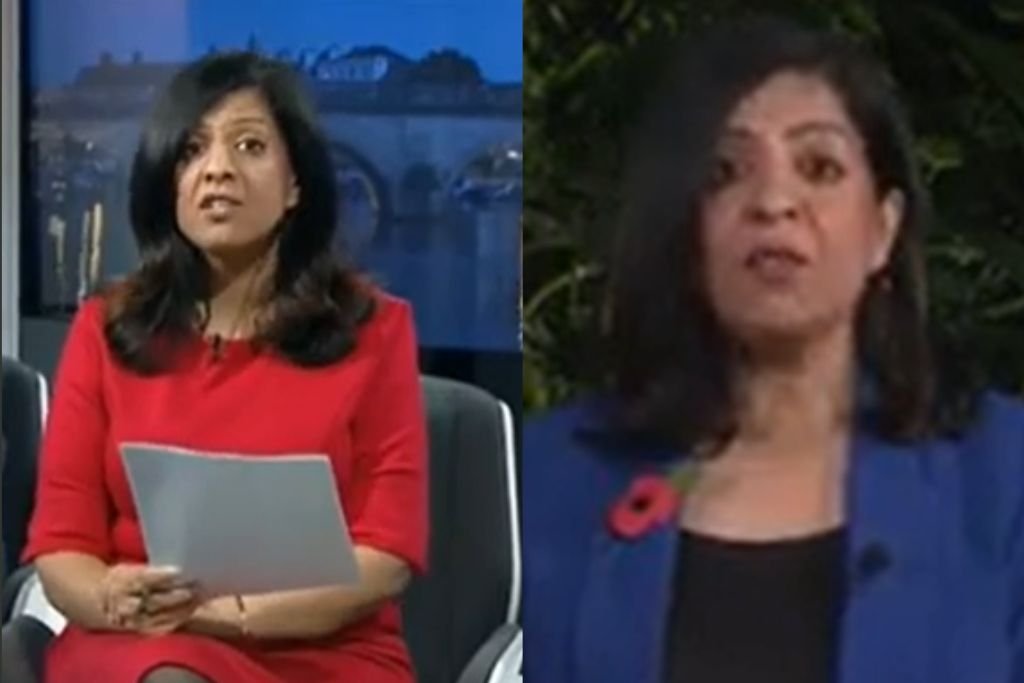
Good evening. Today, we are looking at the remarkable story of Sangeeta Bhabra, a familiar face in British regional broadcasting and a journalist whose career has been closely connected with ITV News Meridian.
For many viewers across the South East of England and the Thames Valley, Bhabra is more than just a television presenter. Over the years, she has become a trusted voice in regional news, delivering stories with calmness, professionalism and a distinctly personal sense of connection.
But behind the television presenter is a much broader story.
Sangeeta Bhabra’s career reflects decades of change in British broadcasting. It is a story about journalism, cultural identity, family responsibility, representation and professional resilience.
She has worked in radio and television, reported from important locations, presented alongside legendary broadcaster Fred Dinenage, received recognition for her journalism and supported the next generation of journalists through mentoring.
So, as we look at her career, we are not simply looking at the story of a television presenter.
We are looking at the journey of a journalist who has spent years telling other people’s stories while gradually becoming part of the story of British regional broadcasting herself.
From Radio to Television
Sangeeta Bhabra’s broadcasting journey did not begin in front of a major television audience.
Like many journalists, she started much closer to the ground.
Her early broadcasting experience reportedly included volunteering at Hospital Radio Reading. For someone beginning a career in journalism, hospital radio could provide an important introduction to the fundamentals of broadcasting.
There, a young Bhabra would have had the opportunity to learn how to communicate with an audience, how to prepare material and, perhaps most importantly, how to understand the responsibility that comes with having a voice behind a microphone.
She later moved into commercial radio, including work with County Sound Radio in Guildford.
Those early radio years helped establish the foundation for the television career that would follow.
Her academic background also had a direct connection with communication. Bhabra studied Linguistics at St Mary’s University, Twickenham, where she gained a Master’s degree.
For a journalist, language is at the heart of everything.
Every introduction, interview question, report and conversation depends on words being clear and precise.
And in Bhabra’s case, her understanding of language would become particularly interesting because she would eventually work across English, Hindi and Punjabi.
From those early radio beginnings, her career gradually moved towards television, eventually bringing her to ITV Meridian.
Becoming a Familiar Face at ITV Meridian
Sangeeta Bhabra would go on to become strongly associated with ITV News Meridian.
Regional television journalism is a very different world from national broadcasting.
National news can focus on governments, international events and major national developments.
Regional news, however, often deals with the things people experience directly in their everyday lives.
It can be about hospitals, schools, transport, local businesses, community campaigns, crime, politics, cultural events or the people living just a few miles away.
And that creates a special relationship between regional presenters and their viewers.
Over the years, Bhabra developed that relationship.
She worked both as a reporter and presenter, covering stories across the Thames Valley and South East of England.
For viewers, her presence became familiar.
Night after night, she would appear on television to introduce the day’s biggest stories and connect audiences with events happening within their own communities.
That familiarity is one of the most important parts of regional journalism.
A presenter may not become a national celebrity, but within a particular region, viewers can develop a strong sense of trust.
And Bhabra’s career demonstrates how that trust can be built gradually through years of consistent work.
Her Partnership With Fred Dinenage
One of the most memorable chapters of Sangeeta Bhabra’s television career came when she began presenting alongside Fred Dinenage.
Dinenage was already one of the best-known figures in British regional television.
His broadcasting career had stretched across decades, and his name was closely connected with ITV regional news.
Then came Bhabra.
The two began presenting together in February 2009 following changes to ITV’s regional news structure.
On paper, they represented two different generations of broadcasting.
Dinenage was an established broadcasting veteran.
Bhabra represented a newer generation of journalists and also brought a different cultural perspective to the television screen.
But somehow, the partnership worked.
Bhabra herself later described them as something of an “odd couple”.
And that difference became part of what made the partnership memorable.
They did not need to be identical.
Instead, their contrasting personalities and professional experiences created a chemistry that audiences came to recognize.
For more than a decade, viewers saw the two presenters working together as part of ITV Meridian’s regional news coverage.
For those audiences, they became familiar faces during the evening news.
And that is one of the special characteristics of regional television.
The presenter is not simply someone reading the news.
Over time, the presenter can become part of the community’s television routine.
More Than a Studio Presenter
While many people know Sangeeta Bhabra primarily from the news desk, her career has involved considerably more than presenting television bulletins.
She has also worked as a reporter, taking stories from the field and bringing them directly to viewers.
Her reporting has included coverage connected with Normandy and commemorations relating to the First World War.
She has also reported from Dover on migration-related issues.
These assignments demonstrate the range expected of a regional journalist.
One day, the story may be about a local community.
Another day, it may involve history and remembrance.
And on another assignment, the journalist may be covering an issue involving politics, migration and human consequences.
That is where the difference between a presenter and a journalist becomes particularly clear.
A presenter communicates the story.
A reporter has to go out and find it.
They have to speak with people, ask questions, understand complicated circumstances and then explain what they have discovered to the audience.
Bhabra’s career has included both sides of that responsibility.
Recognition as Regional Journalist of the Year
In 2015, Sangeeta Bhabra received another important recognition.
She was named Regional Journalist of the Year at the Asian Media Awards.
The award represented a significant achievement in her career.
It recognized her work within regional journalism and highlighted the contribution she had made as a journalist working in mainstream British broadcasting.
But the recognition also had a wider meaning.
British television has changed considerably over the years, particularly in terms of representation.
Bhabra’s presence as a British journalist of South Asian heritage reflected part of that changing media landscape.
However, her award was ultimately recognition for journalism itself.
Regional journalism requires consistency.
It requires accuracy.
It requires an understanding of local communities and the ability to explain stories that matter to ordinary people.
For Bhabra, the award became an important professional milestone in a career that had already developed over many years.
Growing Up With Two Cultural Worlds
Away from the newsroom, Bhabra has also spoken about her experience growing up in Britain.
During South Asian Heritage Month, she reflected on growing up during the 1980s and 1990s while navigating both her Indian heritage and British surroundings.
It was an experience that shaped her understanding of identity.
She has spoken about speaking Hindi, Punjabi and English, and those languages represent more than simple communication.
They connect her with family, culture and heritage.
For a journalist, such experiences can also provide a different understanding of Britain’s increasingly diverse communities.
The audiences watching regional television today are not all the same.
They come from different backgrounds, cultures and generations.
And British regional broadcasting has changed alongside those communities.
Bhabra’s career has therefore developed during a period in which diversity has become increasingly visible within mainstream television.
Her presence has been significant not simply because of her background, but because she has established herself through the work of journalism.
The Family Story Viewers Do Not Always See
When viewers see Sangeeta Bhabra on television, they see a confident and composed journalist.
They see the presenter.
But behind that professional image is a personal story that is far less visible.
Bhabra has spoken publicly about becoming a carer from a very young age.
Her younger brother, Manish, was born when she was seven.
She has explained that he has severe autism, is non-speaking and requires considerable support with everyday life.
This meant that caring responsibilities became part of Bhabra’s life while she was still growing up herself.
It was not something that began when she became an adult.
It was something she experienced from childhood.
In an ITV feature focusing on caring for carers, Bhabra reflected on that experience and spoke to the younger version of herself about what she had gone through.
That story provides a very different perspective on the person viewers see behind the news desk.
The journalist who reports on difficult stories is also someone who has personal experience of family responsibility, disability and the emotional challenges that can come with caring.
It is a reminder that journalists are not separate from the world they report on.
They have their own experiences, families and challenges.
And those experiences can influence the empathy and understanding they bring to their work.
Supporting the Next Generation
As Bhabra’s career has progressed, her role in journalism has expanded beyond television.
She has also become involved in mentoring younger people interested in journalism and media.
For aspiring journalists, experience can be just as valuable as formal education.
Knowing how to conduct an interview is important.
Knowing how to write a story is important.
But understanding newsroom culture, professional expectations, confidence, communication and the realities of broadcasting can often only be learned from someone who has experienced them personally.
That is where experienced journalists can make a difference.
Bhabra has spent decades watching the industry evolve.
She has seen the transformation of radio and television, the rise of digital journalism and the changing way audiences consume news.
By mentoring younger journalists, she has the opportunity to pass some of that experience forward.
In 2026, she was also listed as a Senior Fellow of The John Schofield Trust, further reflecting her connection with journalism development and mentoring.
More Than a Symbol of Representation
When discussing Bhabra’s career, it would be easy to focus entirely on representation.
Her South Asian heritage is important.
Her visibility on British television is important.
Her ability to speak Hindi, Punjabi and English is important.
But her career cannot be reduced to those characteristics.
At the heart of her story is journalism.
She has spent years reporting, presenting, interviewing and communicating with viewers.
Her professional reputation has been built through that work.
And perhaps that is the strongest form of representation.
It is not simply about appearing on television because of where someone comes from.
It is about becoming recognized for what that person can do.
Bhabra’s career demonstrates that both realities can exist together.
She can be an accomplished journalist.
And at the same time, her presence can reflect the changing cultural landscape of Britain.
The Changing World of Regional News
Sangeeta Bhabra’s career also tells us something about the changing nature of regional television itself.
When she entered broadcasting, television was one of the main ways people received visual news.
The evening news bulletin was an important part of the daily routine for millions of households.
Today, the media environment is completely different.
People receive news through smartphones, websites, social media, streaming services and instant notifications.
A major event can appear on a person’s phone seconds after it happens.
So what role does regional television still play?
The answer may be context.
Regional journalism can explain what an event means for a particular community.
It can introduce local voices.
It can connect national developments with people living in specific towns and cities.
And it can provide continuity in an environment where information is increasingly fast and fragmented.
That makes experienced regional journalists particularly important.
Their responsibility is no longer simply to tell viewers what happened.
It is also to help explain why it matters.
A Career Built Slowly
Sangeeta Bhabra’s career is not a story of overnight fame.
It is a story of gradual professional development.
It began with early radio experience.
It continued through commercial broadcasting.
It moved into television.
It developed through reporting and presenting.
Then came the long association with ITV Meridian.
Along the way came her partnership with Fred Dinenage and the recognition of the Asian Media Awards.
Away from the studio, there were also her experiences with family, heritage and caring responsibilities.
And later came her involvement in mentoring.
Each chapter adds something different to the overall picture.
Together, they show a broadcaster who has continued to develop rather than simply remain in one role.
Why Her Story Matters
So, why does the story of Sangeeta Bhabra matter?
Part of the answer is representation.
But perhaps the larger answer is journalism itself.
For years, Bhabra has been telling the stories of other people.
That is one of the unusual things about being a journalist.
The journalist can become familiar to millions of viewers while the details of their own life remain largely unknown.
Every evening, the presenter introduces stories about other people’s achievements, struggles, communities and experiences.
But the presenter rarely becomes the main story.
Bhabra’s career has largely followed that pattern.
She has built recognition not through celebrity culture, but through professional consistency.
She has turned up.
She has reported.
She has interviewed people.
She has presented the news.
And over time, that consistency has created trust.
Looking Ahead in 2026
Now, in 2026, Sangeeta Bhabra remains associated with ITV News Meridian after a broadcasting career that has already crossed several decades.
The industry she entered is very different from the one that exists today.
Radio has transformed.
Television has transformed.
Digital journalism has transformed.
And the way audiences consume information has changed dramatically.
Yet some principles of journalism remain the same.
Accuracy still matters.
Clarity still matters.
Empathy still matters.
Trust still matters.
And perhaps most importantly, the journalist still needs to understand how to tell a story without making themselves more important than the story.
Bhabra’s career reflects those principles.
Her early years in radio established her broadcasting foundation.
Her work at ITV Meridian gave her a long-running relationship with regional audiences.
Her partnership with Fred Dinenage became one of the memorable chapters of her television career.
Her 2015 Asian Media Award recognized her journalistic achievements.
Her reflections on South Asian heritage revealed more about the person behind the presenter.
Her experience as a young carer showed another side of her personal life.
And her mentoring work suggests that her influence may continue through the journalists she helps along the way.
The Woman Behind the Headlines
There is an interesting irony in spending a career presenting the news.
Every day, the journalist tells the audience about other people.
Their successes.
Their struggles.
Their communities.
Their tragedies.
Their achievements.
But the journalist often remains behind the invisible boundary of the television screen.
For Sangeeta Bhabra, that has been her professional world for decades.
To many viewers, she is the composed presenter associated with ITV Meridian.
Within journalism, she is an experienced regional broadcaster and award-winning journalist.
And for aspiring journalists, she is increasingly a mentor and an example of professional longevity.
But beyond all of those descriptions is a person whose story includes family, heritage, language, responsibility, professional friendships and the ability to adapt.
Perhaps that is what makes her career particularly interesting.
She did not build her reputation by trying to become bigger than the stories she reported.
Instead, she built it by understanding that the stories belonged to the people whose lives they described.
And after decades in British broadcasting, that may be one of the clearest definitions of Sangeeta Bhabra’s career:
A journalist who made regional news feel personal.
Not because she made every story about herself, but because she understood that behind every headline, there was a person.